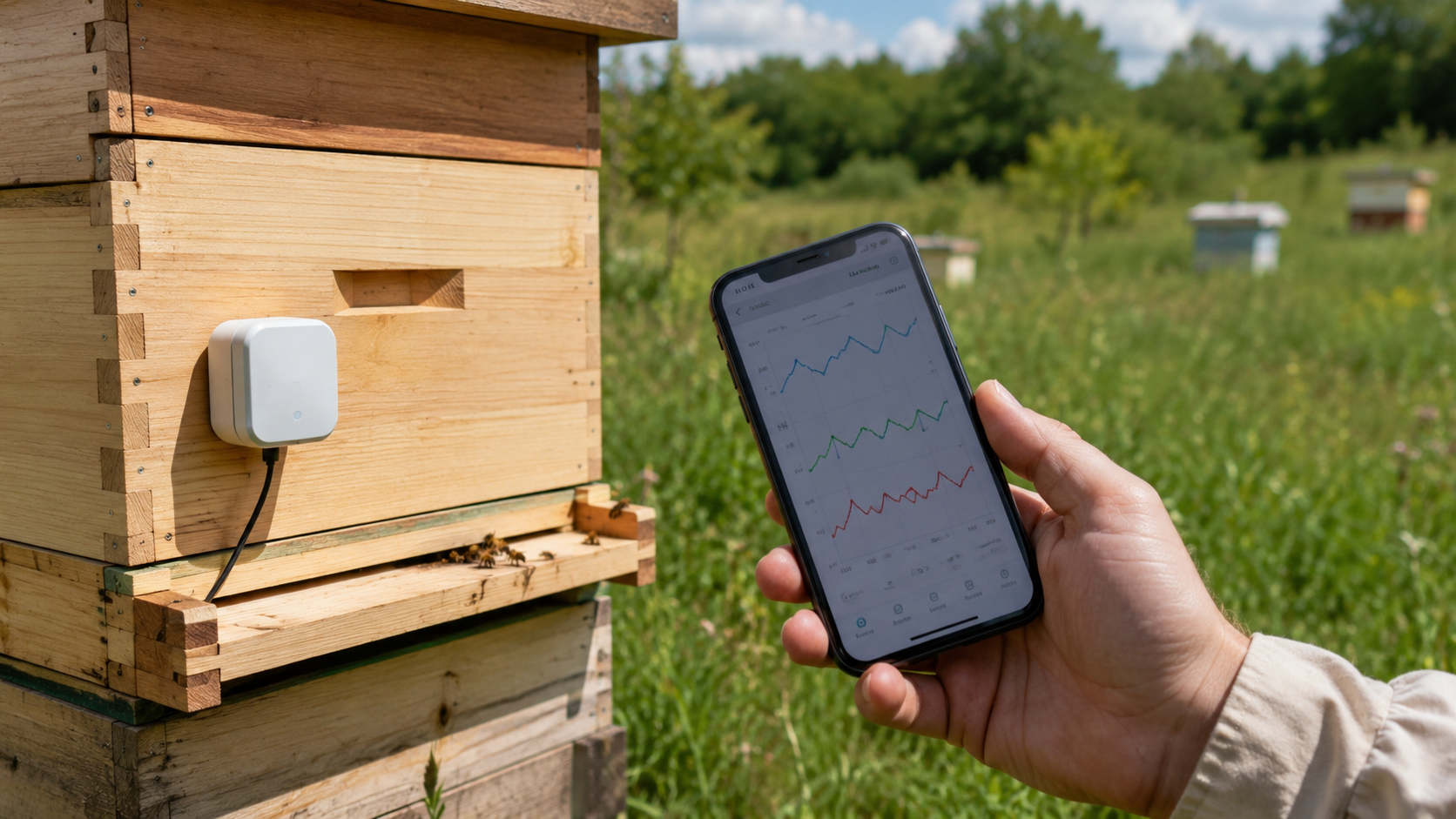
I bought a hive scale because I was tired of guessing whether my colony gained weight during a nectar flow. The graph did not decode the forest, predict climate change, or replace a walk to the hive. It told me something simpler: stores climbed Tuesday, flatlined Thursday, and someone was probably robbing by Saturday.
That is what hive sensors are for — colony management signals you would otherwise learn by hefting boxes, opening hives too often, or finding out too late in winter.
If you are researching sensors with high intent but no affiliate links, this guide is for you: what to measure, what it means, what to skip, and how to get value without turning your apiary into a data center.
The three measurements that matter most
Most backyard setups track hive weight, internal temperature, and sometimes humidity.
Hive weight — A scale under the hive tracks total mass over time. You are watching nectar coming in, honey being capped, swarming (sudden drop), and winter consumption (slow decline).
What you can infer from the curve:
- Strong upward slope during a flow — foragers are bringing nectar in faster than the colony uses it
- Plateau near peak season — may be ready for harvest checks (still verify capped supers in person)
- Sharp overnight drop — swarm, collapse, or robbing; go look
- Steady winter loss — monitor starvation risk before emergency fondant weather
Weight cannot tell you whether the queen is laying well, whether pesticides hit the yard, or how healthy a forest reserve is. You still need brood inspections for that.
Internal temperature — A probe above the brood nest tracks cluster temperature. Brood rearing centers around roughly 93–95°F (34–35°C) when the colony is queen-right — that is why internal temp is more informative than porch air temperature.
- Stable warm band with brood present — colony is likely queen-right during buildup
- Odd dips in spring — possible queenlessness or brood break (confirm with inspection)
- Summer spikes — may prompt shade, ventilation, or water checks on hot afternoons
Temperature alone is not a diagnosis. It is a nudge to open the hive on the right day instead of every sunny weekend.
Humidity (optional) — Less universal than weight and temp. Some beekeepers watch internal humidity for winter cluster moisture in damp climates. Many successful backyard ops ignore humidity and focus on weight plus occasional inspections.
Other sensor types (usually second-tier)
- Entrance counters — forage traffic trends; fun for data nerds, rarely essential in year one
- Acoustic monitors — research and commercial pollination tools; not where most backyard budgets should start
- Infrared or “forest secret” narratives — not standard beekeeping practice; ignore headlines that promise ecosystem surveys from one backyard hive
Do you actually need sensors?
Skip buying this season if you have fewer than two hives and can visit weekly during buildup, if you have not mastered basic inspections and mite testing yet, or if you want a gadget to compensate for irregular hive checks.
Consider sensors if your apiary is far from home, you run multiple hives and want to compare flow gains, winter in your climate makes opening hives risky, or you learn better from graphs than from lifting the back of a box.
Sensors supplement good beekeeping. They do not replace opening the hive, recording mite counts, or talking to a local club.
Budget reality (no shopping links)
Rough tiers in the U.S. hobby market as of 2026 — prices shift, but orders of magnitude are stable:
| Your approach | Typical cost band |
|---|---|
| Bathroom scale + notebook | $0–40 |
| Bluetooth hive scale, hourly logs | Often ~$150–250 per hive |
| Scale + temp/humidity kit | Often ~$250–400 per hive |
| Cellular hubs / multi-hive dashboards | Higher upfront + possible subscriptions |
Read subscription terms before you buy six units.
Setup mistakes that ruin the data
- Unlevel stand — weight readings drift and spike nonsense
- Scale in direct sun while the probe is shaded — you are comparing two different stories
- Expecting one hive to speak for a regional forest — it cannot
- Never calibrating against a manual lift — trust trends, verify extremes in person
- Ignoring the app for three weeks — then blaming the sensor when the colony starved in a heat wave you did not see
How I use one scale without going overboard
One monitored hive is my reference colony. I compare its curve to what I see when I inspect the others. If the reference hive jumps four pounds in five days during blackberry bloom, I know the flow is real and I check supers on the rest. If it drops overnight, I suit up before coffee.
I still do alcohol wash mite counts on schedule. I still look for eggs. The scale just reduces how often I open brood boxes out of anxiety.
A simple decision table
| Your situation | Start here |
|---|---|
| First year, 1–2 hives | Manual heft + notebook |
| 3+ hives, drive-time apiary | One weight scale on strongest colony |
| Hot climate, summer absences | Weight + shade/water plan |
| Winter cold, infrequent visits | Weight trend through dearth and winter |
| Gadget lover, no inspection habit | Fix habits first; skip sensors |
Bottom line
Hive sensors answer beekeeper questions: Did my colony gain weight? Is brood temperature normal? Is winter consumption accelerating? They are not a substitute for affiliate-driven gear reviews or science-fiction forest headlines.
Pick one metric that matches your weakest skill — usually weight for flow timing — run it one season, and keep inspecting in the flesh. The bees still reward hands and eyes more than push notifications.