
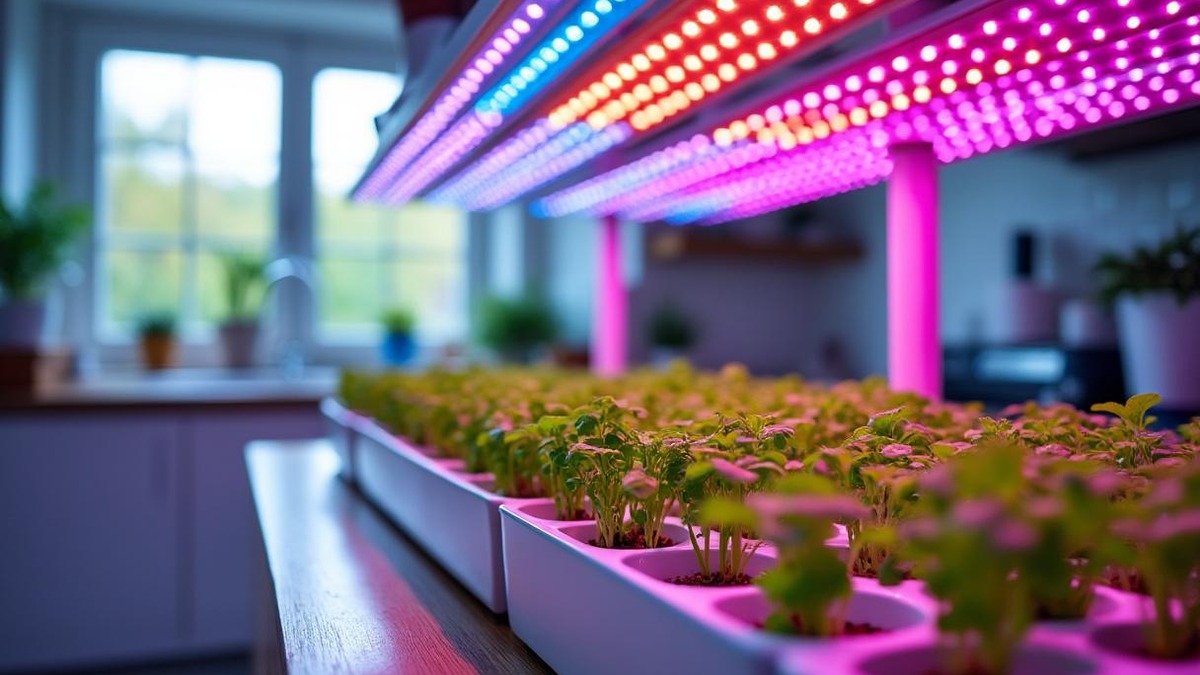
Microgreens are known for their fast growth, rich flavor, and high nutritional value, but lighting plays a much bigger role in their development than many home growers realize. While natural sunlight can grow healthy microgreens successfully, LED grow lights allow growers to control light quality, intensity, and duration more precisely throughout the growing cycle.
The color spectrum of light directly affects how microgreens develop their roots, leaves, flavor compounds, and overall structure. Different wavelengths influence photosynthesis in different ways, which is why many indoor growers rely on specific LED spectrums instead of standard household lighting.
Why Light Spectrum Matters for Microgreens
Plants absorb light through pigments such as chlorophyll, which use specific wavelengths more efficiently than others. Blue and red light are especially important because they drive most photosynthetic activity and influence plant structure during different stages of growth.
Blue wavelengths generally support compact growth, chlorophyll production, and stronger stems, while red wavelengths encourage faster leaf expansion and biomass production. The balance between these colors can influence not only growth speed but also texture, color intensity, and flavor.
Research on controlled-environment agriculture has shown that combining red and blue LED light often improves both yield and nutrient development in microgreens compared to poorly balanced lighting systems.
Blue Light and Early Microgreen Development
Blue light is especially important during germination and early growth stages. It helps microgreens develop dense chlorophyll levels, compact stems, and healthier root systems. Microgreens grown with sufficient blue light often appear darker green and sturdier than plants grown under weak or imbalanced lighting.
However, excessive blue light alone can slow overall growth and reduce leaf expansion. While plants may look compact and healthy, they can mature more slowly if red wavelengths are too limited.
Studies have also shown that higher blue-light ratios may influence nutrient composition and antioxidant development in certain microgreen varieties.
Red Light and Faster Growth
Red light plays a major role in photosynthesis efficiency and biomass production. It helps microgreens expand leaves more rapidly and often accelerates growth rates during the vegetative phase.
Many commercial indoor growing systems rely heavily on red LEDs because they are energy efficient and highly effective for photosynthesis. Red light can also increase stem elongation, which may help some varieties develop taller shoots for harvesting.
Too much red light without enough blue light, however, can lead to leggy or weak microgreens with thin stems and less compact growth.
Does Green Light Help?
Green light was once considered less useful for plant growth because much of it is reflected by leaves instead of absorbed directly. More recent research suggests that green wavelengths still contribute to healthy development, especially when combined with red and blue LEDs.
Green light penetrates deeper into plant canopies and may support more even growth across trays of densely planted microgreens. Some studies also suggest that adding moderate green light can improve plant size and phytochemical development under indoor growing conditions. [oai_citation:2‡MDPI](https://www.mdpi.com/2311-7524/8/3/217?utm_source=chatgpt.com)
Are Full-Spectrum LEDs Better Than Red and Blue Lights?
Many early grow lights used only red and blue LEDs because those wavelengths are most strongly linked to photosynthesis. While these systems can grow microgreens effectively, modern full-spectrum LEDs are becoming more popular for home growing.
Full-spectrum LEDs imitate natural sunlight more closely and usually produce healthier overall plant development. They also make it easier to visually monitor plant color, moisture, and potential disease issues compared to purple-toned red-and-blue lights.
Some recent studies have shown that white or full-spectrum lighting can improve chlorophyll levels, carotenoids, and overall plant quality in certain microgreen species.
The Best LED Spectrum for Microgreens
For most home growers, a balanced full-spectrum LED provides the best combination of growth speed, color development, and ease of use. If using adjustable spectrum lights, many growers achieve strong results with setups that emphasize red light while still including enough blue light for healthy structure.
- Blue light supports compact growth and chlorophyll production.
- Red light increases photosynthesis and leaf expansion.
- Green light may improve canopy penetration and growth balance.
- Full-spectrum LEDs provide more natural overall development.
- Balanced spectrums usually outperform single-color lighting.
Common Lighting Mistakes
One of the most common mistakes is using weak household LEDs that are not designed for plant growth. Standard bulbs may lack sufficient intensity or proper spectral balance for healthy microgreen development.
Another mistake is placing grow lights too far above trays. Even high-quality LEDs lose effectiveness when positioned incorrectly. Most microgreens perform best when lights are placed relatively close while still allowing proper airflow and preventing heat stress.
Using only one color spectrum for the entire growth cycle can also reduce overall plant quality. Balanced lighting generally produces healthier and more flavorful harvests.
Sunlight vs LED Grow Lights
Natural sunlight remains one of the best light sources available for plants because it provides a complete spectrum naturally. During spring and summer, sunny windows or greenhouse setups can produce excellent microgreens without supplemental lighting.
However, LED grow lights offer consistency that sunlight cannot always provide. Indoor growers can maintain stable lighting schedules regardless of weather, season, or window orientation. LEDs also generate less heat and use less electricity than many older indoor growing systems.
For growers producing microgreens year-round, full-spectrum LED systems often provide the most reliable results with the greatest control over growth quality.
Final Thoughts
The best light spectrum for microgreens is usually a balanced combination of red, blue, and full-spectrum white light. Blue wavelengths help develop strong structure and healthy chlorophyll levels, while red light drives rapid growth and efficient photosynthesis.
Modern full-spectrum LED grow lights combine these benefits into a more natural lighting environment that supports consistent harvests, stronger flavor, and healthier-looking microgreens throughout the year.