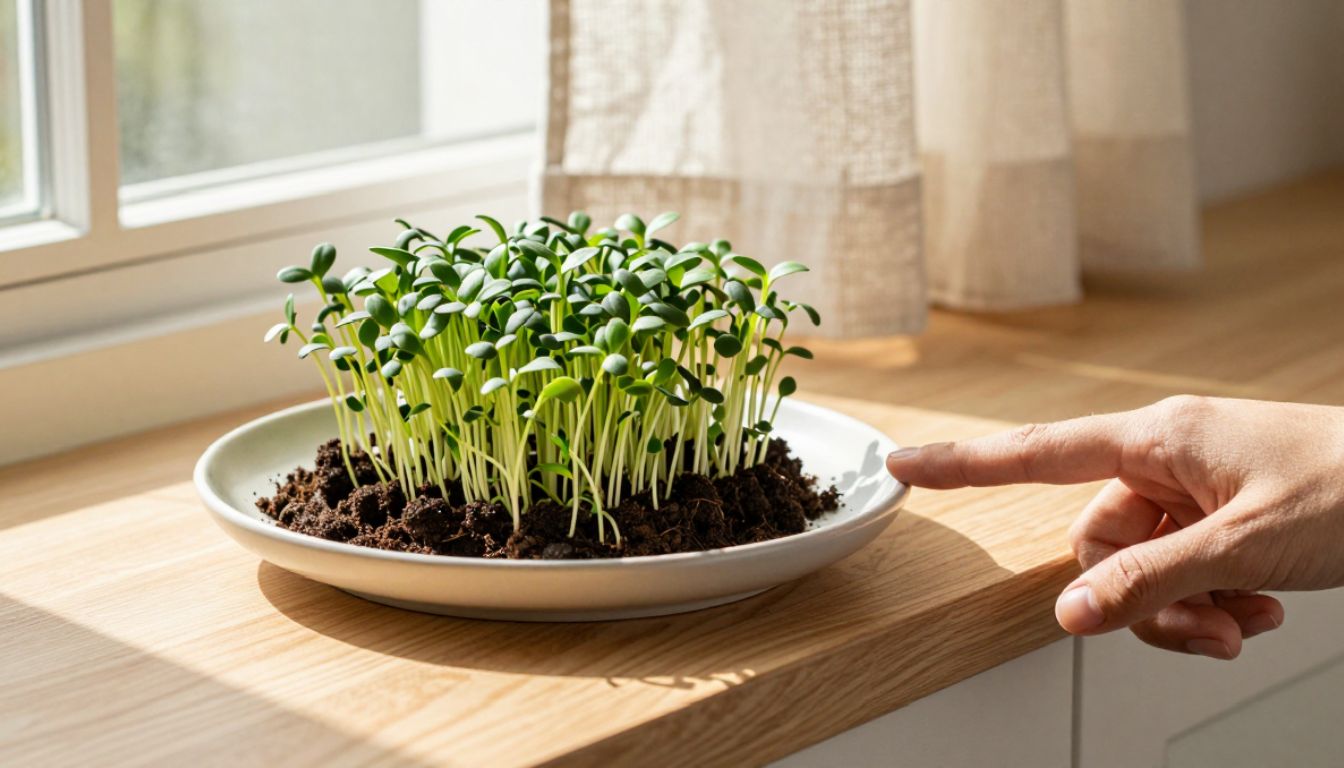
Most people think growing microgreens is about buying the right tray or finding the perfect grow light. But here’s what nobody tells you: your windowsill already has a micro-zone that stays warmer and brighter without harsh sun—usually just a few inches away from the glass and out of the direct midday beam. Once you find that sweet spot, your Chia microgreens will grow faster, stay crisper, and need less fussing. Here’s how to locate it in 60 seconds.
What makes a windowsill spot ‘perfect’ for microgreens
The ideal microgreens spot isn’t the brightest or the warmest—it’s the most consistent. Chia microgreens thrive in bright indirect light, steady warmth between 65–75°F, and minimal drafts. Too close to the glass? You get temperature swings and scorching midday sun. Too far back? Growth slows and stems get leggy searching for light.
The perfect spot balances all three factors without any extra equipment. It’s already on your sill—you just need to know where to look.

The 60-second sweet spot test
You don’t need a light meter or thermometer. Use these three quick checks on a sunny mid-morning (around 10–11 a.m.):
Shadow test for indirect light: Hold your hand flat above the windowsill at different distances from the glass. If your hand casts a soft, blurry shadow, that’s indirect light. A sharp, dark shadow means direct sun—move back a few inches. No shadow at all? You’re too far from the window or the light is too weak.
Hand-feel temperature check: Place your palm flat on the sill surface for five seconds at three spots: right against the glass, six inches back, and twelve inches back. The sweet spot feels warm but not hot—like a mug of tea that’s been sitting for a minute. If it’s cool to the touch, you’re in a draft zone. If it’s uncomfortably warm, you’re too close to direct sun or a heat source.
Draft check: Light a candle or hold a tissue near the window frame and along the sill. If the flame flickers wildly or the tissue flutters, you’ve found a draft. Drafts cause uneven drying and stress seedlings. Move your tray a few inches away from the draft source, or use a folded towel as a buffer.
Run all three tests. The spot that passes all three is your sweet spot. Mark it mentally—or with a piece of painter’s tape.
Placement rules of thumb for consistent growth
Once you’ve identified your sweet spot, a few simple rules will keep it working cycle after cycle:
Distance from glass: Most windowsills have their sweet spot 4 to 8 inches back from the glass. This distance filters harsh midday rays while still catching plenty of light. South-facing windows (in the Northern Hemisphere) often need the full 8 inches; east or west windows can go closer.
Curtain diffusion: If your window gets strong afternoon sun, a sheer curtain acts as a free diffuser. Close it during the brightest 2–3 hours (usually noon to 3 p.m.) to prevent leaf burn. Open it the rest of the day.
Avoid heater and AC vents: Even if a spot feels warm, check for nearby vents. Forced air dries out trays fast and creates hot or cold pockets. If your only good window is near a vent, place a small cardboard shield between the vent and your tray.
Stay away from stove steam spikes: Kitchen windowsills are popular for microgreens, but if you cook often, steam and heat from the stove can spike humidity and temperature unpredictably. Choose a sill at least six feet from the stove, or use a different room.

Tying the sweet spot to the 6-day Chia method
Chia microgreens follow a simple timeline, and placement changes at day 3. Here’s how the sweet spot fits in:
Days 0–2 (covered phase): After sowing, cover your tray with a lid or second tray to create darkness and humidity. During this phase, placement doesn’t matter much—Chia seeds germinate in the dark. Keep the tray anywhere room temperature and out of the way.
Day 3 (uncover and move): On the morning of day 3, remove the cover and move the tray directly into your sweet spot. The seedlings are ready for light, and this is when placement makes the biggest difference. Roots are established, and the cotyledons (first leaves) will green up fast in good light.
Days 4–6 (growth phase): Leave the tray in the sweet spot. Check moisture once a day—if the surface feels dry to the touch, mist lightly or bottom-water for 10 minutes. The sweet spot’s steady warmth and indirect light will keep growth even and prevent the pale, stretched stems you get in low light.
Harvest on day 6 or 7 when the leaves are bright green and about 1.5 inches tall. If they’re still pale or short, give them one more day in the sweet spot.
Adjusting moisture in the sweet spot
Even the perfect spot can dry out faster or slower depending on your home’s humidity. Here’s how to adjust:
- If the tray dries out in less than 24 hours: Your sweet spot may be slightly too warm or near a hidden draft. Move the tray one inch further from the glass, or mist twice a day instead of once.
- If the surface stays wet for more than 36 hours: You’re either overwatering or the spot is too cool and dim. Move closer to the window by an inch or two, and reduce misting frequency.
- If you see mold or slime: Too much moisture and not enough airflow. Move the tray into brighter light (closer to the sweet spot center), reduce water, and crack a nearby window for 10 minutes a day.
The sweet spot should let you water once every 24 hours with no stress.

Why the same spot works cycle after cycle
Once you’ve dialed in your sweet spot, it becomes your microgreens anchor. Seasonal light shifts (the sun’s angle changes throughout the year), but the relative position on your sill stays reliable if you adjust for daylight hours. In winter, you may need to move the tray one inch closer to the glass as days shorten. In summer, pull it back an inch to avoid heat.
Using the same spot also trains your eye. You’ll recognize what healthy growth looks like in that exact light and temperature, making it easier to spot problems early.
Take a photo and repeat
Before you start your next cycle, take a quick phone photo of your tray in the sweet spot. Note the date and any observations (“grew fast,” “needed extra water,” “perfect harvest”). After three or four cycles, you’ll have a visual log that shows exactly what works on your windowsill.
Keep your tray in that same spot every cycle. Consistency is the secret to consistently great microgreens—and you already have everything you need.