Most growers ask the wrong question. They want to know how many days until transplant—25? 30? 35?—but the calendar alone won’t tell you if your tomato seedlings are truly ready. A 28-day-old plant grown in poor light or overcrowded trays can be weaker than a 21-day-old seedling raised with care. The real answer lies in a simple readiness checklist that takes just two minutes to run through.
This article gives you that checklist, plus the typical time windows by season, the hardening-off protocol, and the transplant mistakes that can stall your crop for weeks. Whether you’re a kitchen gardener in Mumbai or managing a half-acre plot in Punjab, these signs work across climates and varieties.
Typical time window from sowing to transplant (by season)
Under ideal conditions—good light, temperatures between 20–25°C, and proper spacing—tomato seedlings are usually ready in 21 to 30 days from sowing.
But India’s seasons change the script:
- Kharif (June–July sowing): High humidity and monsoon clouds slow photosynthesis. Seedlings may take 28–35 days and need extra ventilation to prevent damping-off.
- Rabi (October–November sowing): Cooler nights and bright days are perfect. Seedlings often hit transplant size in 21–25 days.
- Summer (January–February sowing in hills, protected nurseries in plains): Heat accelerates growth but can cause legginess. Expect 22–28 days with shade nets.
These are averages. Your nursery’s microclimate—shade, wind, tray density—matters more than the date on the calendar.

The 5 readiness signs: your two-minute checklist
Run through these five checks before you transplant. If a seedling fails even one, give it more time.
1. True leaves (not just cotyledons)
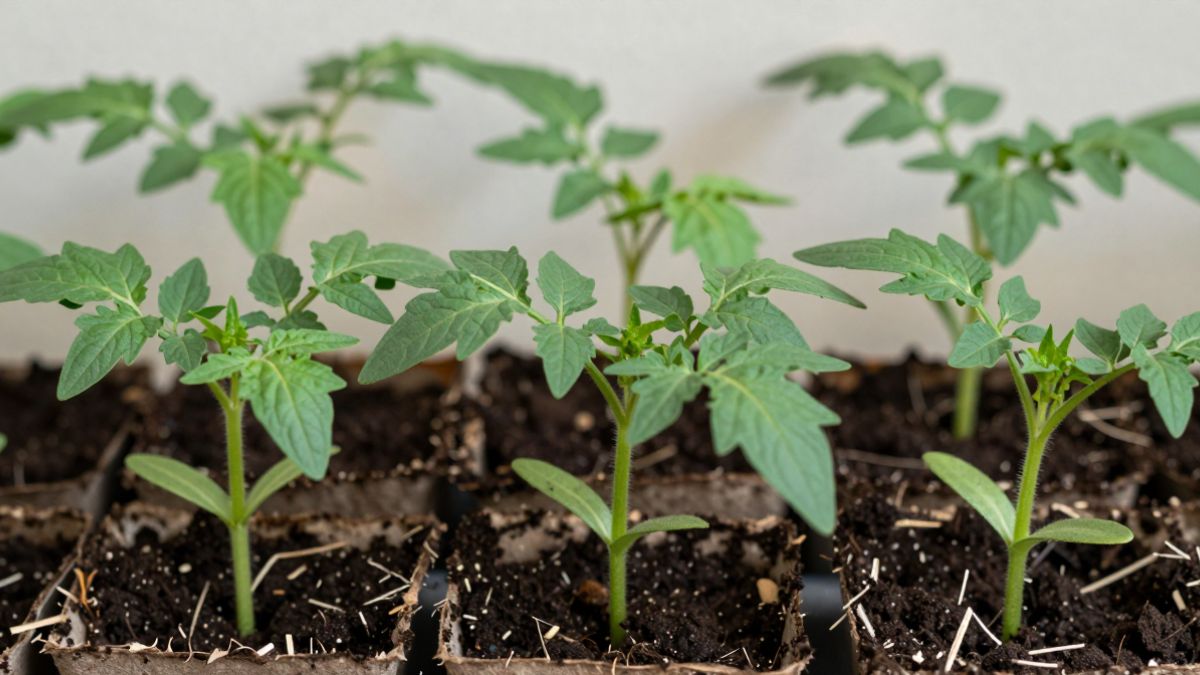
Seedlings need 3 to 4 sets of true leaves—the serrated, compound leaves that look like miniature tomato foliage. The first two rounded leaves (cotyledons) don’t count; they’re just seed reserves.
True leaves mean the plant can photosynthesize independently and recover from transplant shock.
2. Stem thickness
Gently pinch the stem at soil level. It should feel firm and slightly woody, not soft or thread-thin. A pencil-lead thickness (about 2–3 mm) is the minimum.
Leggy, weak stems bend or snap during transplant and struggle to support fruit later.
3. Root fill (the tug test)
Grasp the seedling gently at the base and lift. If the root ball holds the soil plug together without crumbling, the roots have filled the cell or pot.
You should see white root tips at the edges, not circling brown roots (which signal the plant is root-bound and overdue).
4. Height: 10–15 cm is the sweet spot
Taller isn’t better. Seedlings 10 to 15 centimeters tall transplant most successfully. Anything over 20 cm is often leggy and prone to lodging.
If your seedlings are tall but thin, they’ve stretched for light—reduce shade or increase spacing next time.
5. Color: deep green, not pale or purple
Dark green leaves signal healthy nitrogen uptake. Pale yellow-green leaves suggest nutrient deficiency (often nitrogen or iron). Purple-tinged leaves can mean phosphorus deficiency or cold stress.
A weak seedling will stall for two weeks after transplant while it rebuilds reserves.
Hardening-off in 3 days (don’t skip this)
Even a perfect seedling will wilt or sunburn if you move it straight from a protected nursery to the open field. Hardening-off toughens the cuticle and prepares stomata for wind and full sun.
Here’s the three-day protocol:
- Day 1: Move trays to dappled shade outdoors (under a tree or 50% shade net) for 3–4 hours in the morning. Water lightly.
- Day 2: Increase exposure to 6 hours, including some direct sun (early morning or late afternoon). Reduce watering slightly.
- Day 3: Full sun exposure all day, normal watering. Transplant the following morning.
Skip hardening-off and you’ll see leaf curl, tip burn, and transplant shock that can set your crop back by 10–14 days.

Transplant mistakes that stall growth
Even experienced growers make these errors:
Planting too deep or too shallow
Tomatoes tolerate deep planting (they’ll root along the buried stem), but burying the cotyledons invites stem rot. Plant so the soil level matches the nursery plug, or go 1–2 cm deeper if stems are leggy.
Shallow planting exposes roots to heat and drying.
Transplanting in midday heat
Transplant in the early morning (before 9 AM) or late afternoon (after 4 PM). Midday sun causes instant wilting, even if you water heavily. Cloudy days are ideal.
Skipping starter fertilizer
A handful of well-rotted compost or a pinch of DAP (diammonium phosphate) in the planting hole gives roots an immediate nutrient boost. Don’t overdo it—10–15 grams of DAP per plant is enough. Excess nitrogen makes plants leafy but delays flowering.
Ignoring spacing
Crowding seedlings (closer than 45–60 cm for determinate varieties, 60–75 cm for indeterminate) creates competition for light, water, and nutrients. It also traps humidity, inviting fungal diseases like early blight and septoria.
Watering and shade for the first week
The first seven days after transplant are critical.
Watering
- Day 1: Water immediately after transplanting to settle soil around roots.
- Days 2–7: Water daily in the early morning. Soil should stay moist but not waterlogged. Stick your finger 3 cm into the soil; if it feels dry, water. If it’s damp, wait.
- Avoid evening watering in humid climates—it encourages fungal diseases.
Shade
If you’re transplanting in late Rabi (February) or summer, provide temporary shade for 3–5 days using coconut fronds, shade net (30–50%), or even old newspaper tents.
Remove shade gradually, just like hardening-off, so plants adapt to full sun without stress.

Quick FAQ: Hindi and English snippets for growers
टमाटर की नर्सरी कितने दिन में तैयार होती है?
21 to 35 days, depending on season and care. Check the 5 readiness signs, not just the calendar.
Can I transplant tomato seedlings after 15 days?
Only if they have 3–4 true leaves, firm stems, and filled roots. Most seedlings need 21+ days.
My seedlings are tall and thin—should I still transplant?
Yes, but plant them deeper (up to the first true leaves) to encourage adventitious roots. Next time, increase light and reduce crowding.
What if I transplant too early?
Weak seedlings take longer to establish, are more prone to pests, and may never catch up to properly timed plants.
Should I water before or after removing seedlings from trays?
Water trays 2–3 hours before transplanting. Moist soil holds together, protecting roots. Dry soil crumbles; wet soil is too heavy and messy.
Do hybrid and desi varieties have different transplant times?
No significant difference. Both need the same readiness signs. Hybrids may grow slightly faster under optimal conditions.
Your next steps
Print or screenshot the 5-point checklist and keep it near your nursery. Run through it every few days starting from day 18.
If your seedlings pass all five checks and you’ve hardened them off, transplant with confidence—even if it’s only day 22. A ready plant will outperform a calendar-bound one every time.
And if you’re sowing your next batch today (mid-December 2025), you’re perfectly timed for the late Rabi window. Expect transplant-ready seedlings by early to mid-January 2026, just as winter begins to ease and your field soil warms up.