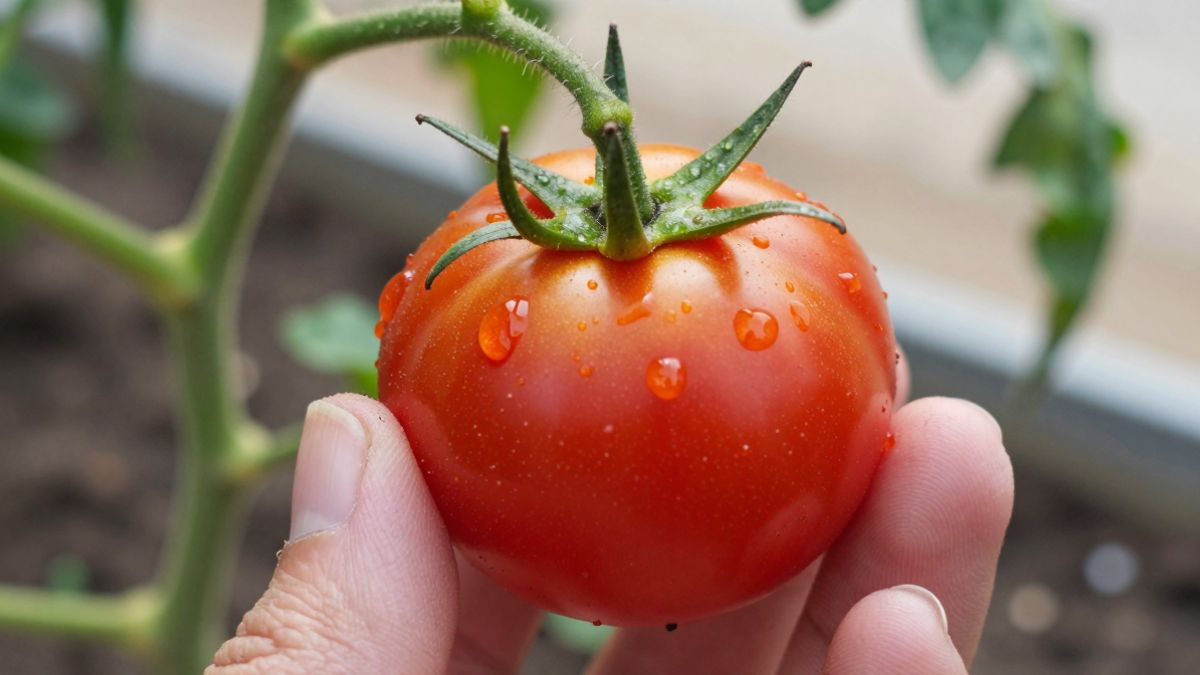
Most home gardeners prune their tomato plants with the best intentions—only to accidentally slash the very stems that would have given them a bumper harvest. If you’ve ever wondered why your neighbor’s balcony is bursting with fat, red tomatoes while yours struggles to ripen a handful, the answer might be hiding in those two innocent-looking stems you snipped off last Sunday.
Tomato pruning is not a one-size-fits-all ritual. The stakes are especially high in India, where our monsoon humidity, intense summer heat, and varied growing seasons demand a smarter, more deliberate approach. Cut the wrong stem, and you’re not just tidying up—you’re sabotaging your yield.
Let’s fix that.
Identify your tomato type in 30 seconds
Before you touch a single leaf, you need to know what kind of tomato plant you’re growing. This is non-negotiable.
Determinate tomatoes grow to a fixed height, set all their fruit at once, and then stop. Think of them as the “bush” types. Popular Indian varieties like Pusa Ruby and Arka Vikas fall into this category. They’re compact, great for containers, and finish their job in 60–80 days.
Indeterminate tomatoes are the climbers. They keep growing, flowering, and fruiting until frost (or disease) stops them. Varieties like Roma, Cherry tomatoes, and many hybrid beefsteaks are indeterminate. They need support, they need space, and they need careful pruning.
Here’s the 30-second test: Look at the main stem. If your plant is bushy, compact, and already loaded with flower clusters at multiple levels, it’s determinate. If it’s tall, leggy, and keeps shooting up with new growth at the tip, it’s indeterminate.
Why does this matter? Because you prune them differently. Prune a determinate like an indeterminate, and you’ll cut off future fruit. Prune an indeterminate carelessly, and you’ll end up with a jungle that invites disease.

What to remove vs what to keep
The golden rule: Remove suckers selectively, never blindly.
Suckers are the small shoots that emerge in the “armpit” between the main stem and a branch. They look harmless, even cute. But left unchecked, they turn into full branches that compete for nutrients and create a dense canopy—perfect for fungal diseases in our humid climate.
For indeterminate tomatoes, remove suckers below the first fruit cluster. Keep 1–2 strong suckers above it to form your secondary stems. This gives you a manageable 2–3 stem system that maximizes airflow and fruit production.
For determinate tomatoes, leave the suckers alone. Seriously. These plants are genetically programmed to stop growing. Every sucker you remove is a potential fruit cluster you’re throwing away. Let them bush out. Your job is to support the weight, not to sculpt the plant.
The 2 stems beginners cut by mistake—how to spot them
Here’s where most gardeners go wrong.
Mistake #1: Cutting the main flowering stem on a determinate plant.
Determinate tomatoes set their fruit on short, stubby stems that branch off the main stalk. These stems look thick and “sucker-like” to the untrained eye, especially early in the season. But if you snap it off, you’ve just deleted an entire cluster of tomatoes.
How to spot it: Flowering stems are thicker, shorter, and emerge at a sharper angle than suckers. They also develop flower buds quickly. If you see even a hint of yellow flowers forming, do not cut.
Mistake #2: Removing the top leader on an indeterminate plant too early.
Some gardeners panic when their indeterminate tomato hits the top of the trellis and “top” it—cutting the main growing tip. This forces the plant to divert energy into side shoots, many of which won’t have time to fruit before the season ends.
How to avoid it: Let the main leader grow until it reaches your maximum support height or until late in the season (mid-November in most of India). Only then should you top it to redirect energy into ripening existing fruit.

Weekly pruning schedule + tying and trellising
Pruning is not a one-time event. Set a weekly reminder.
Week 1–3 after transplant: Remove only the bottom leaves touching the soil. No sucker removal yet—let the plant establish.
Week 4–8 (vegetative growth): Start removing suckers below the first fruit cluster on indeterminate plants. Tie the main stem to your support every 20–25 cm using soft cloth or jute. Avoid tight knots—stems thicken as they grow.
Week 9 onwards (fruiting): Continue removing new suckers. Focus on airflow. If two branches are crossing or rubbing, remove the weaker one.
For trellising, use sturdy bamboo stakes (at least 1.5 meters tall for indeterminate varieties) or a string trellis. In terrace gardens, a simple cage made from welding mesh works beautifully and costs under ₹100.
Monsoon humidity strategy to prevent blight
In India, the real enemy isn’t the heat—it’s the monsoon. High humidity + poor airflow = early blight, late blight, and a host of fungal nightmares.
Here’s your defense:
- Prune aggressively for airflow. If you can’t see through the plant, it’s too dense.
- Remove all leaves touching the ground. Soil splash carries spores.
- Space plants 60 cm apart minimum. Crowding is a death sentence in July and August.
- Water at the base only, early morning. Wet leaves + evening humidity = disease party.
- Apply neem oil spray every 10 days as a preventive, especially from June to September.
If you’re growing tomatoes in containers on a balcony, move them under a roof overhang during heavy rains. Even 24 hours of constant wetness can trigger blight.

Leaf removal near soil line and airflow tips
Once your plant is 30 cm tall, strip all leaves from the bottom 15–20 cm of the stem. This is non-negotiable.
Why? Because soil-borne pathogens—fungi, bacteria, nematodes—hitch a ride on rain splash. The lower leaves are the entry point. Remove them, and you’ve cut off the infection highway.
As the plant grows and sets fruit, continue removing leaves below the lowest ripening cluster. They’re no longer photosynthesizing efficiently anyway—they’re just sucking resources and blocking airflow.
Pro tip: After pruning, compost the healthy leaves. Burn or bin any that show spots, yellowing, or curling.
Fertilizer and watering tweaks after pruning
Pruning is a stress event. The plant needs to heal and redirect energy.
Immediately after pruning:
- Water deeply at the base (not overhead).
- Wait 2–3 days before fertilizing.
Ongoing feeding:
- Use a balanced NPK (19:19:19) during vegetative growth, once every 10 days.
- Switch to a bloom booster (10:52:10) or add bone meal once flowers appear.
- Top-dress with compost every 3 weeks.
Watering:
- Tomatoes need consistent moisture, not flood-and-drought cycles.
- In peak summer (March–May), water daily in the evening.
- In monsoon, reduce frequency but ensure drainage. Waterlogged roots = root rot.

Your next steps
Grab your pruning shears (sterilize them with a flame or alcohol first), head to your plants, and:
- Identify whether they’re determinate or indeterminate.
- Remove only the suckers below the first fruit cluster on indeterminate plants.
- Strip the bottom 15 cm of leaves.
- Tie the main stem to your support.
- Set a weekly calendar reminder to repeat.
You’re not just pruning—you’re engineering a healthier, more productive plant. And in 4–6 weeks, when your neighbors ask how you’re pulling kilos of tomatoes from a single balcony plant, you’ll know exactly why.