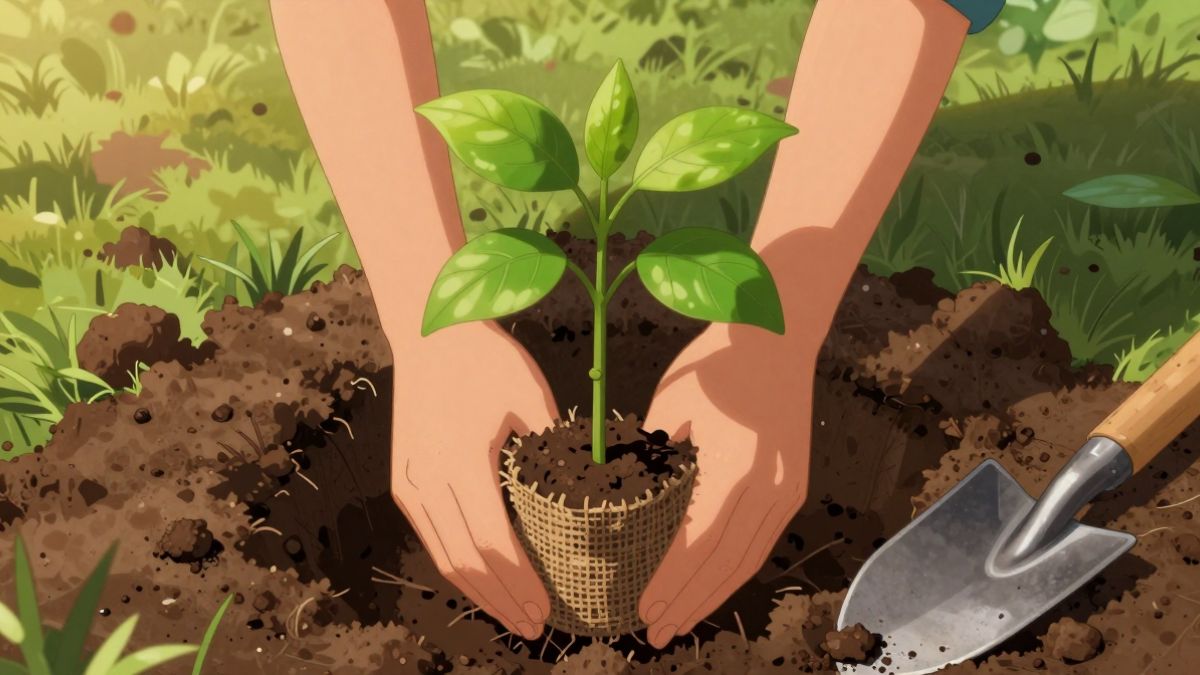
Most trees planted in India don’t make it past their first summer. Not because of neglect—but because of a few critical mistakes made in the first ten minutes.
You’ve seen them: saplings with brown, curling leaves by April, or worse, snapped at the base after a single monsoon gust. The difference between a tree that survives and one that thrives for decades often comes down to what you do before the sapling ever touches soil.
Here’s the pre-plant checklist that changes everything.
Pick the right tree for your space
This is where most people go wrong. They fall in love with a neem or gulmohar at the nursery, without asking three critical questions:
- How much shade does this spot get? Full-sun species like amla or jamun will languish under a building’s shadow. Shade-tolerant species like curry leaf or jackfruit handle partial sun better.
- What’s underneath? Tree roots can crack compound walls, lift paving stones, and choke underground pipes. Fast-growing species like eucalyptus and bamboo are notorious for aggressive root systems. For small gardens, choose slow growers like pomegranate or custard apple.
- How much water can you realistically provide? A mango tree in Rajasthan needs a different watering commitment than one in Kerala. Match the species to your climate and your schedule.
If you’re in a metro with limited space, dwarf or semi-dwarf varieties of guava, lemon, and chikoo work beautifully in large containers.

The mistake that kills most saplings
Here it is: digging a pit that’s too small and filling it with the same poor soil you just removed.
Most home gardeners dig a hole just big enough to fit the root ball, drop the sapling in, cover it, and walk away. By June, the tree is struggling.
Why? Because roots need loose, nutrient-rich soil to spread. Compact clay or builder’s rubble creates a “pot effect”—the roots circle endlessly, unable to anchor or feed.
The fix:
- Dig a pit that’s twice the width and 1.5 times the depth of the root ball.
- Mix the excavated soil with equal parts compost, cocopeat, and a handful of neem cake powder.
- If your soil is heavy clay, add river sand to improve drainage.
- If it’s sandy, add more compost to retain moisture.
This prep work takes 20 minutes. It buys your tree years.
Step-by-step planting: Depth, mulch, and staking
Planting depth matters more than you think.
Place the sapling so the top of the root ball sits level with or slightly above the surrounding ground. Planting too deep suffocates roots and invites collar rot.
Fill the pit halfway with your soil mix, water it thoroughly to eliminate air pockets, then fill the rest. Press gently—don’t compact.
Mulch ring:
Create a 5 cm layer of dry leaves, coconut husk, or straw in a ring around the base, leaving a 10 cm gap from the trunk. This keeps soil cool, locks in moisture, and suppresses weeds. In Indian summers, mulch can reduce watering frequency by half.
Staking:
If your sapling is taller than 1 metre or you’re in a windy area, stake it. Use soft cloth strips (old dupattas work perfectly) to tie the trunk to a bamboo pole. Avoid wire or nylon rope—they cut into bark as the tree grows.
Remove the stake after six months. Leaving it longer weakens the trunk.

Watering schedule for the first 90 days
This is the window where most trees are won or lost.
December to February (Winter):
Water every 3–4 days. Soil dries slower in cooler months. Overwatering now invites fungal issues.
March to May (Summer):
Water daily in the morning or late evening. For saplings in pots or very sandy soil, consider twice a day during peak heat.
June to September (Monsoon):
Reduce to once a week or stop entirely if rainfall is consistent. Check soil moisture by pressing a finger 5 cm deep—if it’s damp, skip watering.
October to November (Post-monsoon):
Resume watering every 2–3 days as temperatures drop.
After 90 days, roots are established enough to seek water independently. Taper off gradually.
Protection: The threats no one mentions
Ants:
Red ants farm aphids on tender shoots, weakening new growth. Tie a strip of grease-coated cloth around the base, or dust the trunk with turmeric powder weekly.
Goats and stray cattle:
In semi-urban and rural areas, a single goat can strip a sapling overnight. Build a simple thorn-bush fence or use chicken wire for the first year.
Sunscald:
In harsh summer sun, young bark can crack and peel. Whitewash the trunk up to 60 cm with a lime-water paste, or wrap it in jute cloth.
Monsoon wind:
July and August winds uproot poorly anchored saplings. Double-check staking before the monsoon arrives.

Micro-habit: The 2-minute weekly check
Set a phone reminder for the same day each week. Walk up to your tree and do this:
- Look at the leaves. Yellowing? Curling? Spots? Early detection prevents bigger problems.
- Feel the soil. Too dry? Too wet? Adjust your schedule.
- Check the base. Any ants, fungus, or damage to the bark?
- Inspect the stake and ties. Are they cutting into the trunk? Loosen or remove.
This ritual takes two minutes. It builds a relationship with the tree. You’ll notice problems before they become crises.
What happens next
By this time next year, your tree will have doubled in height. Its roots will have spread wide and deep. It will need far less from you—maybe a bucket of water during dry spells, a little compost in the monsoon.
But the work you do now—in the first ten minutes, the first 90 days—decides whether it survives or thrives.
So before you plant, pause. Prep the pit. Match the species to your space. Mulch, stake, and protect.
That’s the difference.