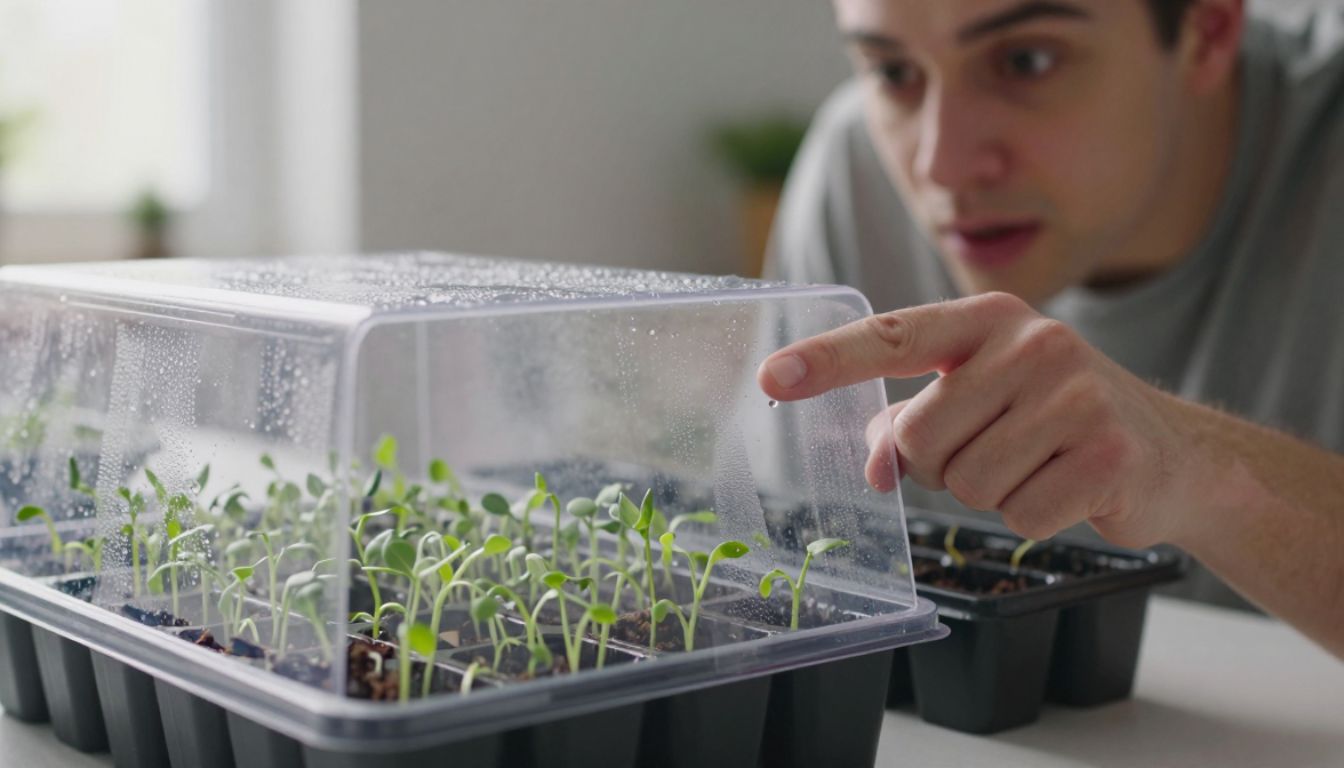
Home growers panic when they see fuzzy white growth on their microgreens trays. They toss the crop, bleach everything, and swear they’ll never try again. But most microgreens don’t actually die from mold—they die from what growers do next.
The real killer? Overwatering and poor air circulation, often triggered by the fear of mold itself. When you see white fuzz, your first instinct is to water less and seal the tray to “contain” the problem. That creates the exact suffocating, stagnant environment where true mold thrives. Meanwhile, what you thought was mold in the first place was probably harmless root hairs—a natural part of healthy seedling development.
What you’re seeing isn’t always mold
Microgreens grow fast. In their first 3–5 days, many varieties—especially broccoli, radish, and mustard—develop fuzzy white root hairs along the stem base and roots. These hairs help the plant absorb water and nutrients.
Root hairs look alarming if you’ve never seen them before. They’re wispy, white, and clustered. But they have a few key differences from mold:
- Root hairs grow in straight lines along the stem or root. Mold grows in random, webby patches.
- Root hairs disappear when misted with water. Mold stays fuzzy and may even spread.
- Root hairs don’t smell. Mold smells sour, musty, or like decay.
If you’re unsure, spray the area lightly with a water bottle. Root hairs will mat down and become nearly invisible. Mold will remain puffy and three-dimensional.

The real killers: overwatering and stagnant air
Once growers misidentify root hairs as mold, they make two fatal mistakes.
First, they stop watering or misting, fearing moisture will “feed the mold.” Microgreens need consistent moisture to germinate and grow. When the growing medium dries out, seeds fail to sprout, stems wilt, and the crop dies before it ever had a chance.
Second, they cover trays too long or skip ventilation. Many beginners use blackout domes or stacked trays during germination, which is fine for the first 2–3 days. But if you leave them covered for 5+ days without airflow, you create a humid, oxygen-starved environment. That’s when true mold (usually white, gray, or green fuzzy patches on the soil or seeds) takes over.
Mold spores are everywhere. They only become a problem when conditions are perfect: high humidity, low airflow, and decomposing organic matter (like unsprouted seeds).
How to prevent actual mold without killing your crop
You don’t need fancy equipment or chemicals. You need consistent habits that balance moisture and airflow.
Use clean, well-draining growing medium. Coconut coir, peat-based mixes, or hemp mats work well. Avoid garden soil, which harbors more spores and compacts easily.
Pre-soak seeds only when needed. Larger seeds like sunflower, pea, and wheatgrass benefit from an 8–12 hour soak. Smaller seeds like broccoli and radish don’t need it. Over-soaking invites rot.
Water from the bottom after day 3. Once seeds have germinated, place trays in a shallow tray of water for 10–15 minutes, then drain. This keeps the surface drier and discourages surface mold.
Remove the blackout cover by day 3. As soon as you see most seeds sprouting, remove the dome or top tray. Let them breathe. If your home is dry, mist lightly once or twice a day—but don’t leave standing water.
Run a small fan nearby. Gentle air movement is one of the most effective mold deterrents. A clip-on fan on low, pointed near (not directly at) your trays, keeps air circulating without drying out the medium.
Increase seed density slightly. Sparse seeding leaves more exposed soil, which can dry out or grow mold. A dense, even carpet of seeds shades the medium and creates a microclimate that’s easier to manage.
Remove any true mold immediately. If you see fuzzy growth on the soil or a patch of seeds that didn’t germinate, scoop it out with a spoon. Don’t let it sit and spread.
What to do if mold has already taken hold
If you catch mold early—before it covers more than 10% of the tray—you can often save the crop.
Increase airflow immediately. Move the tray to a well-ventilated area or set up a fan.
Remove affected areas. Use a spoon or tweezers to lift out moldy seeds or soil. Don’t disturb healthy greens nearby.
Mist with diluted hydrogen peroxide. Mix 1 part 3% hydrogen peroxide with 10 parts water in a spray bottle. Lightly mist the surface. This won’t harm plants but can slow mold spread. Use sparingly—overuse can stress seedlings.
Harvest early if needed. If mold is spreading fast, harvest the healthy greens now, even if they’re a day or two younger than ideal. Rinse them well and use immediately.
If more than a third of the tray is affected, compost it and start fresh. It’s not worth the risk.
Why this matters more in late 2025
As of late December 2025, more Americans are growing food at home than at any point in the last decade. Grocery prices remain high, and microgreens—fast, nutritious, and space-efficient—are a gateway crop for beginners.
But the learning curve is steep, and mold panic is the #1 reason new growers quit after their first tray. The irony? Most of those “moldy” trays were perfectly healthy. The plants died because the grower, terrified of contamination, stopped caring for them correctly.
Understanding the difference between root hairs and mold, and knowing that moisture + airflow (not moisture alone) is the key, will save you dozens of trays, hours of frustration, and a lot of wasted seed.
Your next steps
If you’re growing microgreens now, check your trays. Look for white fuzz. Spray it lightly with water. If it vanishes, you’re fine—those are root hairs. If it stays, increase airflow and remove any problem spots.
If you’re about to start your first tray, commit to these three habits:
- Uncover seeds by day 3.
- Water from the bottom after germination.
- Keep air moving gently around your trays.
Do that, and you’ll skip the mold panic entirely. Your microgreens will grow fast, healthy, and dense—and you’ll wonder why you ever worried in the first place.