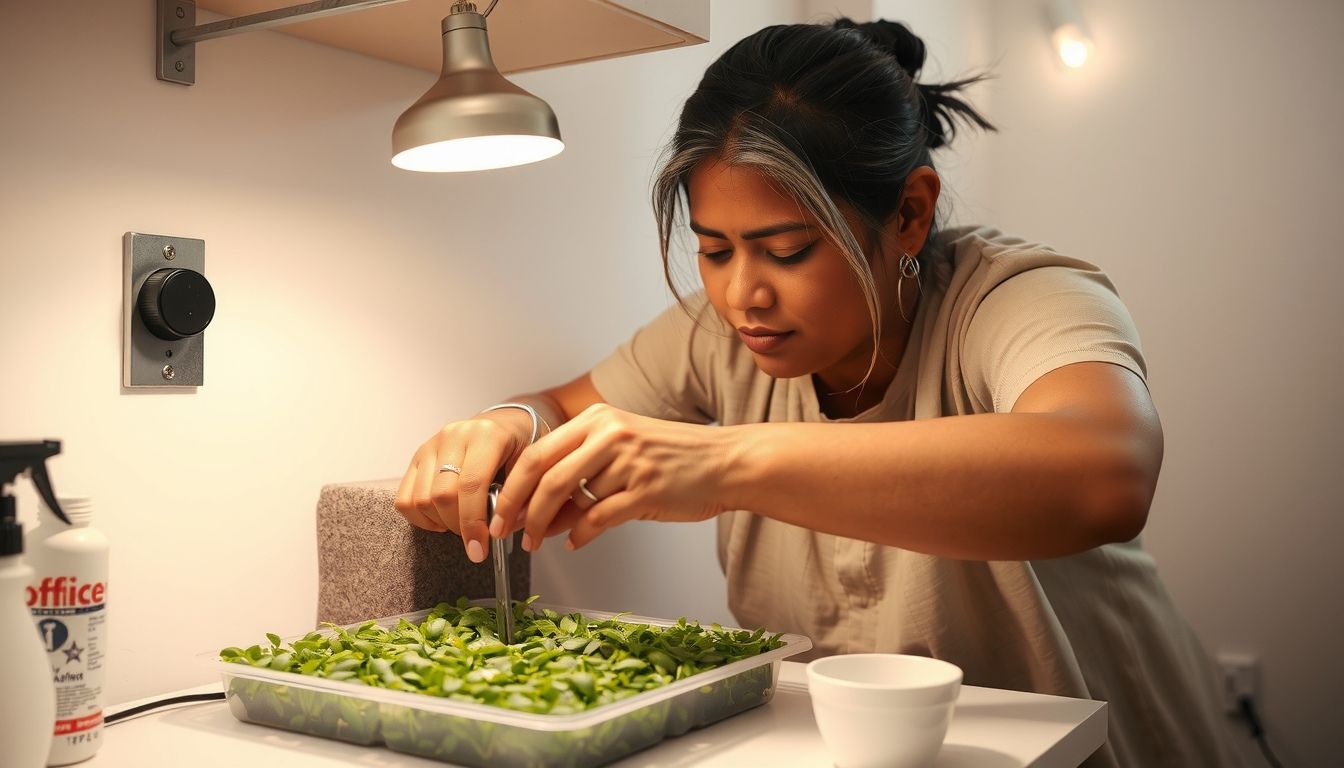
Most apartment gardeners in India give up on microgreens after one moldy, disappointing tray. The culprit? They assume natural sunlight is the only way, and when their north-facing balcony or windowless kitchen fails them, they quit. Here’s the truth: you don’t need a single ray of sunlight to grow restaurant-quality microgreens indoors—just a ₹150 LED bulb, a plastic tray, and seven days.
This isn’t about expensive grow lights or hydroponic systems. It’s about a dead-simple setup that works in Mumbai flats, Bangalore studio apartments, and Delhi rentals with zero outdoor space. Let’s break it down.
Microgreens basics in 60 seconds
Microgreens are vegetable or herb seedlings harvested 7–14 days after germination, right when the first true leaves appear. They pack 4–40 times more nutrients than their mature counterparts (red cabbage microgreens, for instance, contain 40 times more vitamin E than mature cabbage).
Unlike sprouts (which you grow in water and eat root-and-all), microgreens grow in a medium and you snip only the stems and leaves. They’re crunchy, intensely flavored, and shelf-stable for 5–7 days in the fridge. Think of them as living garnish that transforms dal, dosa, sandwiches, and salads.
The entire growth cycle happens in a 10×12-inch tray on your kitchen counter. No soil-filled pots. No garden. No guesswork.

Best beginner seeds for Indian apartments
Start with these five foolproof varieties. All germinate fast, tolerate beginner mistakes, and cost ₹30–₹80 for a 50-gram pack:
- Methi (fenugreek): Earthy, slightly bitter. Germinates in 24 hours. Harvest in 7 days.
- Moong (mung bean): Crunchy, mild. Huge seeds, nearly impossible to fail. Harvest in 5–6 days.
- Radish (red or white): Peppery kick. Grows thick and fast. Harvest in 8–10 days.
- Mustard: Spicy, bold. Tiny seeds, big yield. Harvest in 7–8 days.
- Coriander: Familiar flavor, slower (12–14 days), but worth it.
Avoid sunflower and pea shoots for your first tray—they need deeper trays and more light intensity.
Buy seeds labeled “for microgreens” or “organic sprouting seeds” from brands like Nutriorg, Urban Platter, or local organic stores. Regular vegetable seeds often come treated with fungicides.
LED light specs simplified: wattage, distance, timer
This is where apartments win. You need 12–16 hours of light per day, and a cheap LED bulb delivers exactly that—no sun required.
What to buy:
A 9-watt or 12-watt white LED bulb (cool white or daylight, 6000–6500K color temperature). Cost: ₹100–₹200. Brands like Philips, Syska, or Wipro work perfectly. Skip the expensive “grow lights” marketed online—they’re overkill for microgreens.
Setup:
Screw the bulb into a simple desk lamp or a hanging bulb holder (₹50 at any hardware shop). Position it 15–20 cm (6–8 inches) above the tray. If the bulb is too far, seedlings stretch and become leggy. Too close (under 10 cm), they dry out fast.
Timer:
Plug the lamp into a mechanical timer switch (₹150–₹250 on Amazon or at electrical stores). Set it for 14 hours on, 10 hours off. This mimics a natural day-night cycle and prevents overheating.
Total cost for the light setup: ₹250–₹400. It lasts for multiple harvests.
Tray and growing medium options: cocopeat, soil, mats
Tray:
Use any shallow plastic tray, 2–3 cm deep. Disposable aluminum trays (₹20 for a pack of 3), takeaway containers, or nursery seedling trays all work. Poke 4–5 drainage holes in the bottom with a heated nail or screwdriver tip.
Growing medium (pick one):
- Cocopeat: Lightweight, reusable, no mess. Soak a cocopeat block (₹40 for 650g) in water, squeeze out excess, and spread 1–2 cm in the tray. Best for beginners.
- Garden soil: Cheap, but can harbor mold spores. If you use it, sterilize by microwaving damp soil for 90 seconds or baking at 180°C for 20 minutes.
- Jute or hemp mats: Pre-cut biodegradable mats (₹30–₹50 each). Soak, place in tray, sprinkle seeds. Zero mess, but slightly pricier per harvest.
Avoid cotton or paper towels—they dry out too fast under LED light.
Watering from below to prevent mold
Mold is the #1 killer of apartment microgreens. The fix? Bottom watering.
Here’s how:
- After sowing seeds, mist the surface lightly with a spray bottle.
- Place your tray (with drainage holes) inside a larger tray or plate.
- Pour water into the outer tray, not on the seeds. The medium will wick moisture up through the holes.
- Let it sit for 10–15 minutes, then remove excess water.
Do this once a day (twice in hot, dry weather). The surface stays drier, airflow improves, and mold spores can’t take hold.
Pro tip: For the first 2–3 days, cover the tray loosely with a damp cloth or another inverted tray to maintain humidity during germination. Once sprouts appear, remove the cover and switch on the LED.

Harvest and storage
When the first true leaves appear (the second set, after the initial cotyledons), your microgreens are ready. For most varieties, that’s day 7–10.
How to harvest:
Use clean kitchen scissors. Snip just above the soil line. Harvest the entire tray at once, or cut what you need and let the rest grow another day.
Storage:
Rinse gently, spin-dry in a salad spinner or pat with a clean towel, and store in an airtight container lined with a paper towel. They’ll stay crisp in the fridge for 5–7 days.
One 10×12-inch tray yields roughly 100–150 grams of fresh microgreens—enough for a family of four for a week.
5 common mistakes and quick fixes
1. Seeds piled too thick
Symptom: Mold, weak stems, tangled roots.
Fix: Spread seeds in a single, even layer. They should almost touch, but not overlap.
2. No drainage holes
Symptom: Waterlogged medium, root rot, sour smell.
Fix: Always poke holes. Always bottom-water.
3. LED too far away
Symptom: Tall, pale, floppy seedlings (etiolation).
Fix: Lower the light to 15 cm. Increase hours to 16 if needed.
4. Forgot to remove the cover
Symptom: Mold explosion on day 3.
Fix: Uncover as soon as you see green sprouts (usually 48–72 hours).
5. Using old or treated seeds
Symptom: Patchy germination, chemical smell.
Fix: Buy fresh organic seeds every 6 months. Store in a cool, dry place.

Your first tray starts today
You don’t need a balcony, a green thumb, or a ₹5,000 grow-light kit. You need a ₹150 LED bulb, a plastic tray, cocopeat, and methi seeds. Set it up tonight, water from below tomorrow, and by January 2, 2026, you’ll be snipping your first harvest.
Microgreens are the rare urban gardening win: faster than houseplants, cheaper than store-bought organic greens, and infinitely more satisfying than watching a money plant grow one leaf per month. Start small, start now, and let your windowless kitchen prove everyone wrong.