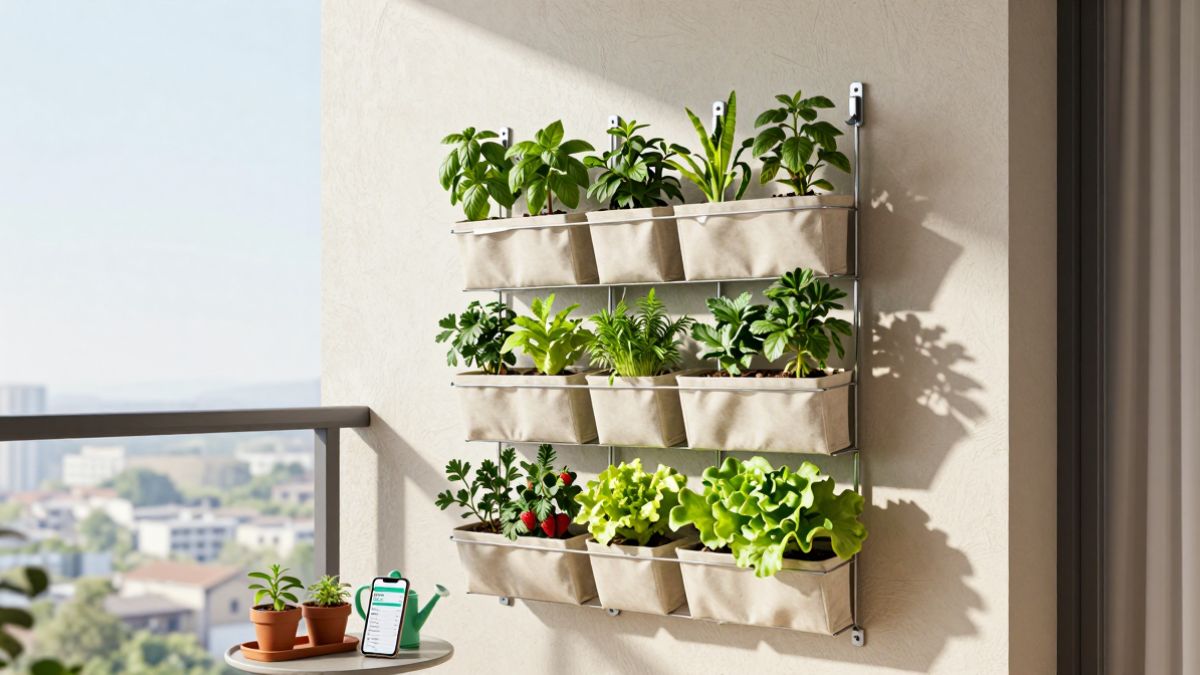
Your balcony wall is staring at you. Blank. Boring. Maybe a little judgmental. You’ve scrolled past those lush vertical gardens on Instagram—cascading greens, fresh herbs within arm’s reach—and thought, “Not for me. Too complicated. Too messy. My landlord will kill me if I drill holes.”
Here’s the truth: You don’t need a single screw to turn that bare wall into a productive mini farm. No drilling. No permanent damage. And if you’re in India, no monsoon meltdowns either.
Vertical gardening has earned a bad reputation because most systems are designed for temperate climates with predictable weather. They’re heavy, they leak, and they turn into fungal nightmares the moment humidity spikes. But with the right approach—lightweight materials, smart drainage, and monsoon-ready plant choices—you can grow food and flowers on any vertical surface, even if you’re renting.
Let’s build something that actually works.
Choose your system: Pocket planters vs tier stands vs railing boxes
The foundation of a no-drill vertical garden is the structure itself. You have three main options, and each suits different spaces and budgets.
Pocket planters are fabric or felt panels with sewn pockets that hang from a curtain rod or tension pole. They’re lightweight, fold flat for storage, and cost between ₹400–₹1,200. Perfect for narrow balconies or indoor walls. The downside? They dry out quickly and need frequent watering.
Tier stands are freestanding metal or wooden shelves that lean against a wall. Think ladder-style plant stands or tiered baker’s racks. They hold multiple pots at different heights, give you flexibility to swap plants in and out, and cost ₹800–₹3,000. Best for balconies with floor space.
Railing boxes clip or tie onto balcony railings without tools. They’re stable, get excellent airflow, and are ideal for herbs and trailing flowers. Prices range from ₹200–₹600 per box. The catch? You’re limited to the length of your railing.
Pick the system that fits your space and commitment level. If you’re testing the waters, start with railing boxes or a small tier stand. You can always scale up.

Weight and drainage basics for balconies
Most balconies in Indian apartments weren’t designed to hold a jungle. A standard balcony can safely support around 150–200 kg per square meter, but that includes furniture, people, and your garden.
Water is the silent weight villain. A saturated 10-liter pot can weigh 12–15 kg. Multiply that by five or six pots, and you’re flirting with structural limits.
The solution? Go lightweight from the start.
- Use plastic or resin containers, not ceramic or concrete.
- Choose shallow pots (15–20 cm depth) for herbs and greens. Most edible plants don’t need deep roots.
- Ensure every container has drainage holes. No exceptions.
- Place a shallow tray or saucer under each pot to catch runoff, but empty it within an hour to prevent mosquito breeding.
If you’re using a tier stand, position it near a corner or against a load-bearing wall. Distribute weight evenly across shelves.
Lightweight potting mix that won’t compact
Garden soil is too heavy and too dense for vertical setups. It compacts quickly, suffocates roots, and turns into a soggy, anaerobic mess during monsoon.
The ideal potting mix for vertical gardens is light, airy, and fast-draining. Here’s a simple recipe:
- 40% cocopeat (retains moisture without weight)
- 30% vermicompost or well-rotted compost (nutrients)
- 20% perlite or rice husk ash (drainage and aeration)
- 10% neem cake powder (slow-release fertilizer and pest deterrent)
Mix thoroughly before filling pots. This blend weighs roughly one-third less than regular garden soil and drains in seconds, which is critical when rain hammers your balcony for days.
If you’re using pocket planters, add an extra 10% perlite to speed up drainage. Fabric pockets can hold moisture longer than you’d expect.

Best plants for vertical success: Herbs, greens, trailing flowers
Not all plants thrive in vertical setups. You need species that tolerate shallow roots, handle heat and humidity, and bounce back from occasional neglect.
Top performers for Indian balconies:
- Herbs: Coriander, mint, curry leaves, basil (Tulsi and Thai varieties), fenugreek (methi). Harvest regularly to keep them bushy.
- Greens: Spinach (palak), amaranth, lettuce, rocket (arugula). Grow in succession—plant a new batch every two weeks.
- Trailing flowers: Petunia, nasturtium, portulaca, million bells. They cascade beautifully from railing boxes and top-tier pots.
- Compact vegetables: Cherry tomatoes, chili peppers, dwarf beans. These need slightly deeper pots (20–25 cm) but deliver serious yields.
Avoid plants with aggressive root systems (like drumstick or papaya) or those that need constant moisture (like ginger in its early stages).
Rotate your crops seasonally. Winter (November–February) is ideal for leafy greens and herbs. Summer (March–June) suits peppers, tomatoes, and flowering vines.
Low-cost irrigation: Wick bottles and drip lines
Watering a vertical garden can feel like a part-time job. Pocket planters dry out in hours during summer. Tier stands mean climbing up and down with a watering can.
Wick irrigation is the laziest, cheapest solution. Push one end of a cotton rope or thick jute twine deep into the potting mix. Drop the other end into a water bottle placed below the pot. Capillary action pulls water up as the soil dries. One bottle can keep a small pot hydrated for 3–5 days.
For tier stands, DIY drip lines work beautifully. Buy a 10-meter drip irrigation kit online (₹300–₹600). Connect it to a bucket elevated above your highest pot. Gravity does the work. Adjust drip emitters so each pot gets a slow, steady trickle.
Set a timer on your phone to check soil moisture every morning. Stick your finger 2 cm into the mix. If it’s dry, water. If it’s damp, skip it. Overwatering kills more vertical gardens than underwatering.

Monsoon-proofing (fungus, algae, mosquito control)
Monsoon is when vertical gardens either thrive or collapse. High humidity, low sunlight, and stagnant water create perfect conditions for fungal diseases, algae blooms, and mosquito larvae.
Fungus control: Powdery mildew and damping-off are common. Spray neem oil solution (5 ml neem oil + 1 liter water + 2 drops dish soap) every 10 days as a preventive. Prune dense foliage to improve airflow. Remove any yellowing or spotted leaves immediately.
Algae: Green slime on soil surfaces and pot rims means too much moisture and not enough drainage. Top-dress pots with a thin layer of dry cocopeat or wood chips to block light from the soil surface.
Mosquitoes: Empty all saucers and trays daily during monsoon. If you’re using wick systems, add a few drops of neem oil to the water bottle—it won’t harm plants but will deter larvae.
Move sensitive plants (like basil and lettuce) under a covered section of your balcony if possible. They’ll tolerate lower light better than constant drenching.
A 30-day planting plan to get results fast
You don’t need to wait months to see progress. Here’s a realistic timeline to go from bare wall to harvest.
Days 1–3: Set up your structure. Hang pocket planters, position tier stands, or clip railing boxes. Prepare potting mix.
Days 4–7: Fill containers and plant fast-growing seeds—coriander, methi, spinach, radish microgreens. Water gently.
Days 8–14: Seedlings emerge. Thin them if overcrowded (one plant every 5 cm). Set up wick bottles or drip lines.
Days 15–21: Transplant nursery-bought herb saplings (mint, basil, curry leaves) into larger pots on middle or top tiers. They’ll establish faster than seeds.
Days 22–30: First harvest! Snip coriander leaves, pinch basil tops, pull radish microgreens. Sow a second batch of greens in empty pockets.
By the end of the month, you’ll have a functioning system and fresh ingredients for your kitchen. Scale up from there—add a trailing petunia, try a chili plant, experiment with lettuce varieties.
The wall that once judged you? It’s working for you now.