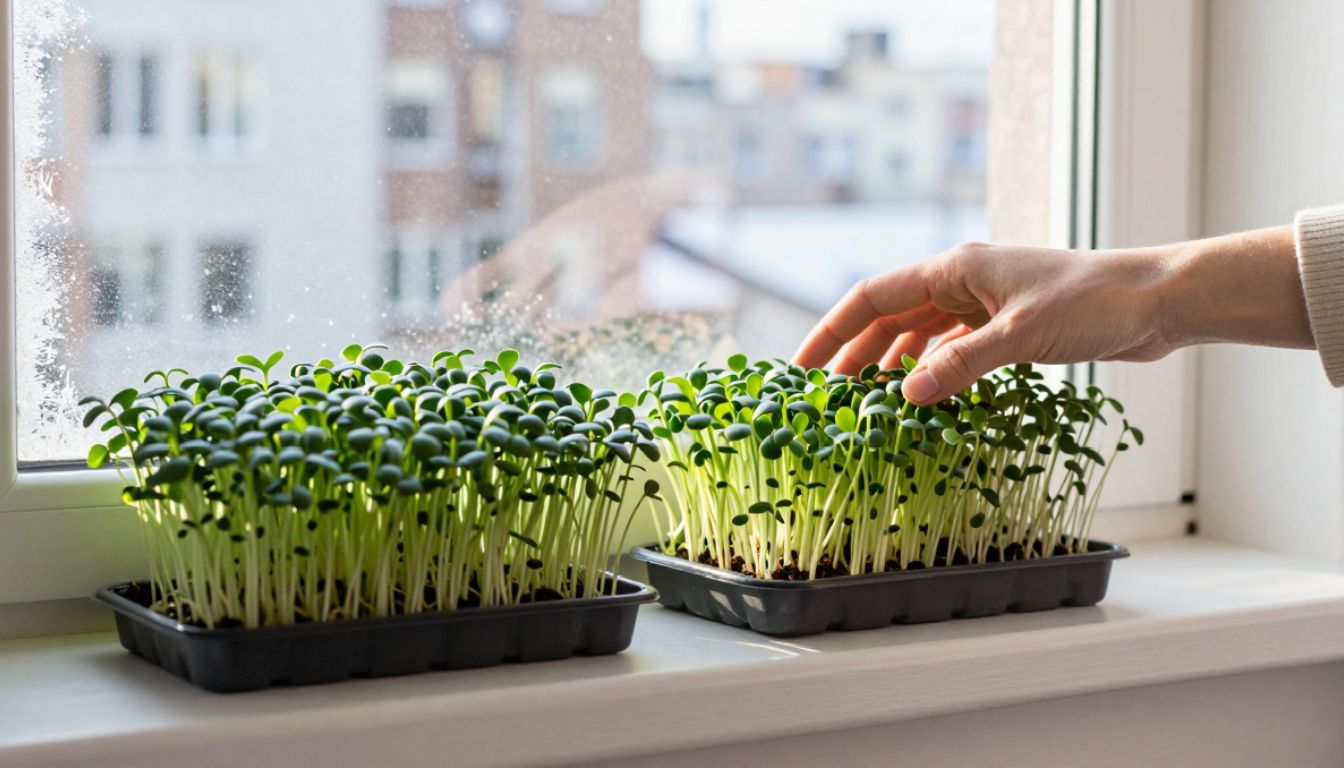
I stared at my windowsill—barely ten inches deep, crammed between a radiator and a stack of books—and laughed at the idea of growing food there. Then I scattered a tablespoon of chia seeds onto a damp paper towel in a shallow dish, and six days later, I was snipping fresh greens onto my morning eggs. The payoff wasn’t just the harvest; it was realizing that tiny space doesn’t mean tiny potential.
Chia microgreens turned my doubt into a system. No soil bags, no grow lights, no counter space sacrificed. Just a compact setup that fits anywhere a coffee mug would, grows faster than most herbs, and makes that narrow sill feel like a working garden.
The setup: smaller than you think
You don’t need a planter box or even a pot. A shallow dish—think the kind you’d use for soy sauce or a candle—works perfectly. I used a small ceramic tray about four inches across.
Line the bottom with a damp paper towel or a thin layer of coco coir (a compressed coconut fiber disk, available at any garden shop). The paper towel route is faster and cleaner for beginners.
Sprinkle chia seeds evenly across the surface—about one tablespoon per small dish. They’ll swell and form a gel coat within minutes, so don’t pile them. They need contact with moisture, not each other.
Mist lightly with a spray bottle until the towel is damp but not pooling. Cover the dish with a second plate or plastic wrap to trap humidity.
The first 48 hours: darkness and patience
Chia seeds germinate in the dark. For the first two days, keep the dish covered and away from direct light. I tucked mine behind a stack of mugs on the counter.
Check once a day. If the paper towel looks dry, mist lightly. The seeds will sprout pale, threadlike roots and tiny folded leaves. By day two, you’ll see a carpet of white stems pushing upward.
This is the stage where most people panic and think they’re doing it wrong. The pale color is normal—chlorophyll only kicks in once they see light.
Day three: uncover and move to the windowsill
Once the stems are about half an inch tall, remove the cover and move the dish to your windowsill. Indirect light is ideal—bright but not scorching. I placed mine on the north-facing sill where it gets soft morning glow.
Within hours, the stems start turning green. By day four, the leaves unfold and darken. By day five, they’re standing upright, dense, and vibrant.
Keep misting once or twice a day. The paper towel should stay damp, but not soggy. Overwatering invites mold; underwatering makes the greens wilt and taste bitter.
Make it feel bigger: stagger your starts
The real trick to turning a small windowsill into a steady supply is repetition, not expansion. Start a new dish every three to four days.
I keep three small trays in rotation. One is ready to harvest, one is mid-growth, and one just sprouted. It takes up less than a foot of sill space, but I’m never without fresh greens.
You can use mismatched dishes, old takeout containers, or even jar lids. The system scales by frequency, not footprint.
What success looks like by day six
By day six, your chia microgreens should be about two inches tall, with bright green leaves and crisp stems. They’ll have a mild, slightly nutty flavor—nothing like the mucilaginous texture of soaked chia seeds.
To harvest, snip just above the paper towel line with clean scissors. Don’t pull—the roots are shallow and the whole mat will lift. Cut what you need and leave the rest; they’ll hold for another day or two in the dish.
Rinse the greens gently under cold water if you used coco coir (paper towel setups are usually clean enough to skip this step). Pat dry and use immediately, or store in a sealed container in the fridge for up to 24 hours.
What to do with them
Chia microgreens are mild enough to pile onto almost anything. I use them on:
- Scrambled eggs or omelets
- Avocado toast
- Grain bowls or salads
- Sandwiches (they add crunch without the bitterness of arugula)
- Smoothies (blend a handful for a nutrient boost without altering flavor)
They’re packed with omega-3s, fiber, and antioxidants—more concentrated than the mature plant. A small handful delivers more nutrition than a full salad of iceberg lettuce.
Troubleshooting the tight space
If your windowsill is cluttered, try these workarounds:
- Stack vertically: Use a small wire rack or a tiered plant stand to create levels.
- Rotate daily: If one side gets more light, turn the dish 180 degrees each morning to keep growth even.
- Use the edge: Place the dish at the very front of the sill, where it won’t block other items but still catches light.
- Go mobile: Keep the dish on a small tray with a handle, so you can move it to follow the sun or clear space when needed.
I’ve grown chia microgreens on sills as narrow as six inches. The dish doesn’t need to sit flat—propped at a slight angle works fine as long as the moisture stays distributed.

Why chia works better than other seeds in small spaces
Chia seeds are mucilaginous—they form a gel when wet, which means they don’t need soil to anchor. This makes them ideal for paper towel or hydroponic setups.
They also germinate faster than most microgreens (sunflower, pea shoots, or radish all take 7–10 days). Chia is ready in six, sometimes five if conditions are warm.
And because the seeds are tiny, a single tablespoon yields a dense mat of greens. You’re not wasting space on sparse growth.
Start with one dish, scale by habit
The beauty of this system is that it doesn’t ask you to commit to a full garden. Start with one dish. If you forget to mist it or it molds, you’ve lost a tablespoon of seeds and a paper towel.
But if it works—and it almost always does—you’ll start another. Then another. Before long, that “too small” windowsill becomes a rotating supply of fresh greens, and the only thing you’ll regret is not starting sooner.
Chia microgreens proved to me that constraint isn’t the enemy of growth—it’s just the frame. You don’t need more space. You need a system that fits the space you have.