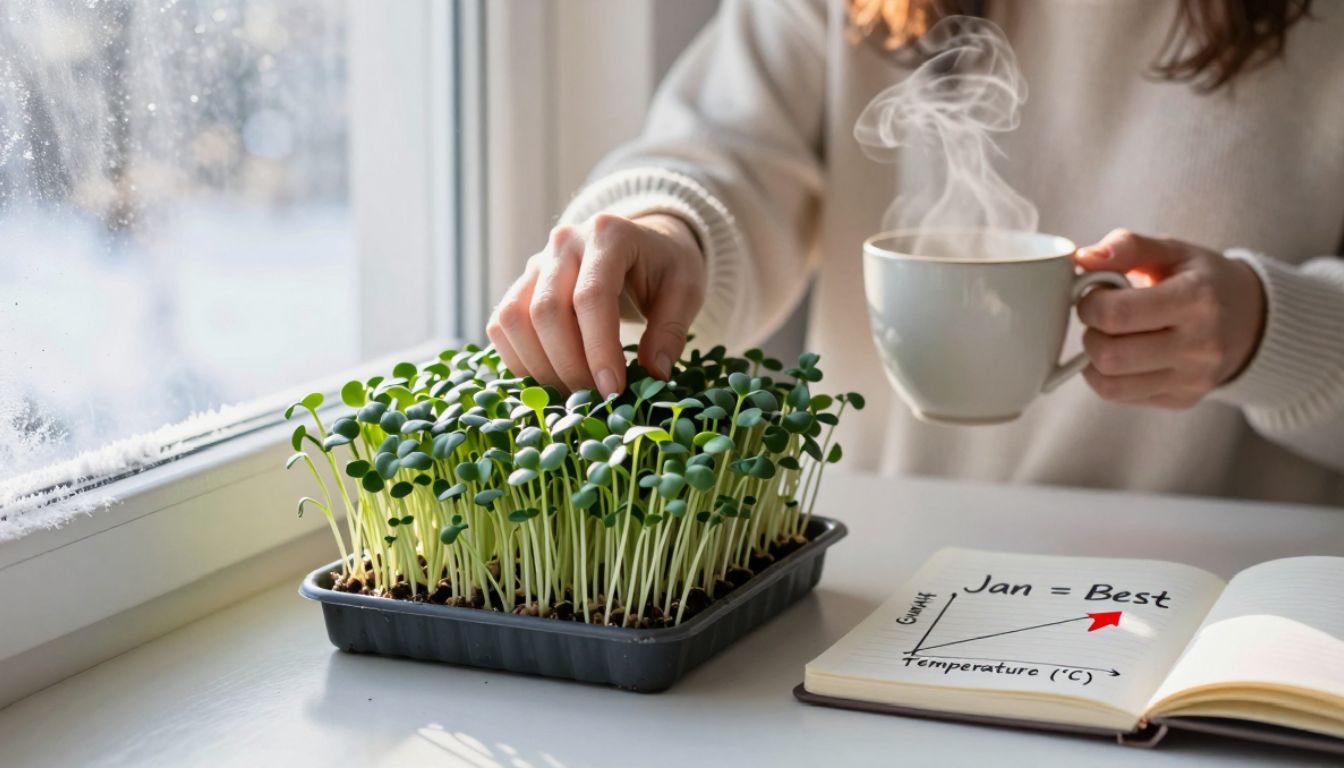
Most gardeners assume January is a tough month for microgreens—short days, weak sun, cold windowsills. But chia microgreens don’t just survive in January; they thrive. And the secret isn’t better light or a grow lamp. It’s something quieter: the steady, cool indoor environment that winter naturally creates.
While summer kitchens swing between blasting AC and afternoon heat spikes, January rooms hold a calm, consistent temperature. That stability is exactly what chia seeds need to germinate without slime, grow without leggy stretching, and stay crisp through harvest.
Why January’s indoor climate is secretly ideal
Chia microgreens are mucilaginous—they release a gel coating when wet. In warm, stuffy conditions, that gel becomes a breeding ground for mold and rot. But in January, most homes sit between 60–68°F (15–20°C), especially near windows or in unheated corners. That range keeps the gel stable, the roots healthy, and the air circulation effective.
January light is also gentler and more diffuse. You’re not battling the intense afternoon rays that scorch trays in July or cause uneven drying. Instead, you get soft, consistent daylight that encourages steady growth without stress. Chia doesn’t need blazing sun—it needs predictable photosynthesis, and winter delivers that.
Finally, January routines are calmer. You’re home more often, checking trays daily, misting when needed. There’s less vacation chaos, fewer forgotten waterings. That human consistency pairs perfectly with the plant’s need for attention in its first 7–10 days.

What January conditions actually look like in your home
If you live in the northern US, your home in early January likely has:
- Cooler ambient temps (especially mornings and evenings)
- Lower humidity from heating systems, but not desert-dry
- Indirect or low-angle sunlight through windows
- Fewer temperature swings compared to spring or fall
These conditions create a natural germination chamber. Chia seeds sprout in 24–48 hours, and the cooler air prevents them from overheating under their cover. The lower humidity means you can mist without over-saturating. The gentle light means seedlings don’t stretch desperately toward the window.
If you’re growing chia microgreens for the first time, January is your training-wheels month. You’ll see what healthy growth looks like without fighting the environment.
How to grow chia microgreens to match January’s advantage
To replicate or enhance the natural January setup:
Start with indirect light placement. Put your tray on a north-facing windowsill, or 3–5 feet back from a south-facing window. Chia doesn’t need direct sun until day 5 or 6. Before that, ambient daylight is enough.
Water from below, not above. Chia’s gel coating makes top watering messy and risky. Use a shallow tray with drainage holes, set it in a larger tray with 1/4 inch of water, and let the roots wick up moisture. Refill every 12–24 hours as needed.
Cover for the first 2–3 days, then vent daily. Use a humidity dome, plastic wrap, or an inverted tray to keep moisture in during germination. Once sprouts appear, crack the cover for 10–15 minutes each day to let fresh air in and prevent mold. By day 4, remove the cover entirely.
Mist lightly once a day (optional). If your heating system dries the air below 30% humidity, a single light mist in the morning keeps the gel from crusting. Don’t soak—just a fine spray over the top.
Harvest at 7–10 days. Chia microgreens are ready when the first true leaves appear and the stems are 2–3 inches tall. They’ll taste mild, slightly nutty, and crunchy. Cut just above the soil line with clean scissors.
If your home is too warm or too dry: 3 quick adjustments
Not everyone has a cool, stable January environment. If your home runs hot (above 72°F / 22°C) or very dry (below 25% humidity), try these:
Move to a cooler room. Grow your chia tray in a guest bedroom, basement, or garage with a window. Even a 5-degree drop makes a difference in slime prevention.
Shorten cover time. If you notice condensation pooling under the dome by day 2, remove it earlier. High heat + high moisture = mold risk. Vent twice a day instead of once.
Adjust misting frequency. In dry homes, mist twice a day (morning and evening) until the gel stays glossy. In humid homes, skip misting entirely and rely on bottom watering alone.
These tweaks let you recreate January’s advantage even if your indoor climate isn’t cooperating.
Use January as your baseline, then replicate it year-round
The real power of growing chia microgreens in January is learning what success feels like. You’ll see healthy germination rates, clean green growth, and minimal troubleshooting. That gives you a reference point for every other month.
When summer arrives and your kitchen heats up, you’ll know to move the tray to a cooler spot or add a small fan for airflow. When spring humidity spikes, you’ll remember to vent more aggressively. January teaches you the ideal conditions, and the rest of the year is just about recreating them.
If you’ve been putting off starting microgreens because you thought winter was the wrong time, flip that assumption. January is the easiest month to start, especially with chia. The environment is working with you, not against you.
Grab a shallow tray, a handful of chia seeds, and a spot near a window. By January 10th, you’ll have your first harvest. By February, you’ll understand exactly what these plants need—and you’ll be able to grow them any time of year.