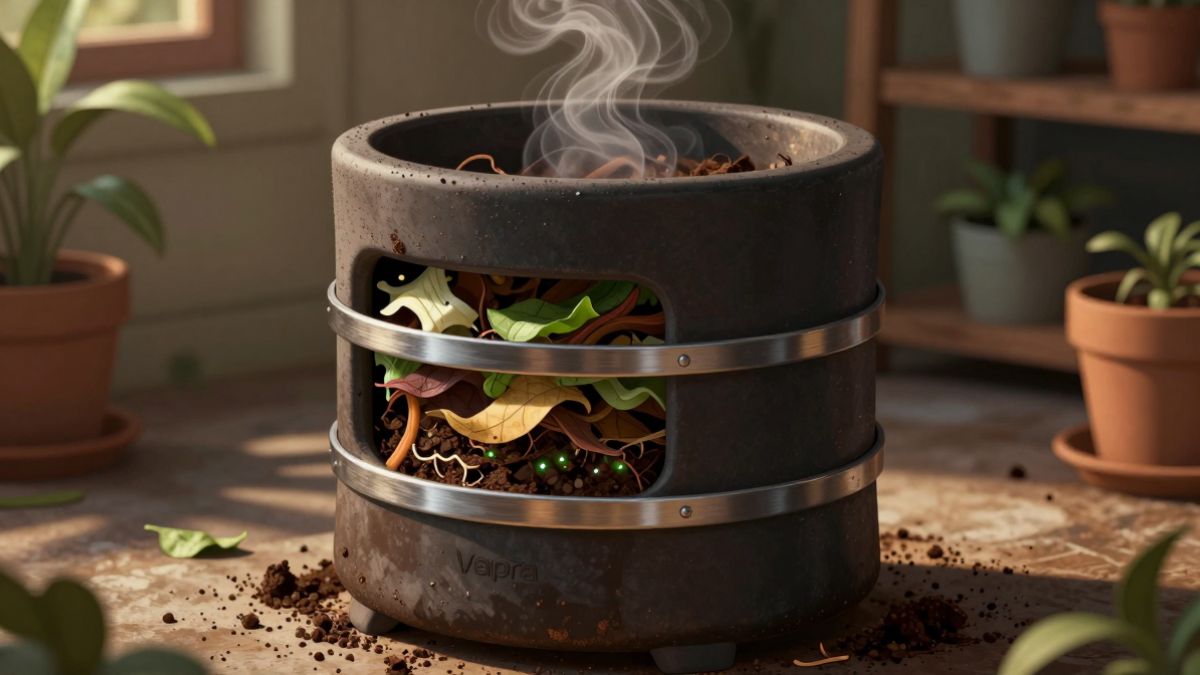
Are you one click away from buying a Vapra composter because you’re tired of fruit flies and that weird smell every time you open your kitchen bin? Hold on. Before you spend several hundred dollars on what’s essentially a kitchen dehydrator with a composting label, let’s talk about what you’re actually getting—and whether it fits your life.
I’ve spent weeks researching electric composters, and here’s the truth: Vapra units work, but they don’t work the way most people think they do. Let me walk you through the reality check I wish I’d had before testing one myself.
What it claims to do vs. what it actually produces
Vapra markets itself as a composting solution, but what it creates isn’t technically compost—it’s dehydrated, ground-up food waste. Real compost requires microbial breakdown over time, which happens in traditional outdoor bins or tumblers. The Vapra heats, grinds, and dries your scraps into a crumbly powder in 4-8 hours.
This matters because the output still needs to break down in soil before plants can use it. It’s a pre-processed soil amendment, not finished compost. Think of it as a shortcut to landfill diversion, not a complete composting system.
That said, the output is odorless, shelf-stable, and far easier to handle than rotting vegetable peels. If your goal is convenience and you have limited outdoor space, that trade-off might work for you.

Best use-cases: small households and odor concerns
The Vapra shines in specific situations:
- Apartment dwellers with no outdoor composting access
- Small households generating 1-2 pounds of daily scraps
- People sensitive to odors who can’t tolerate traditional compost bins
- Urban gardeners who need a clean way to recycle kitchen waste indoors
It struggles with large families or anyone producing more than the 2-3 liter daily capacity. You’ll need to run multiple cycles, which brings us to the next issue.
Hidden costs: filters, electricity, and maintenance
Here’s where the sticker price gets complicated. Beyond the $300-500 initial purchase, expect:
- Carbon filters: Replaced every 3-4 months at $15-25 each
- Electricity: Runs 4-8 hours per cycle, adding roughly $5-10 monthly to your bill
- Grinding blades: May need replacement after a year of heavy use
- Maintenance time: Cleaning the bucket and grinder after each cycle (15-20 minutes)
If you process scraps daily, you’re looking at an additional $100-150 annually in operating costs. That’s not a dealbreaker, but it’s rarely mentioned in marketing materials.

What to do with the output
This is critical: you can’t just sprinkle Vapra output on your plants and expect magic. The material is highly concentrated and can burn roots if applied directly. Best practices include:
- Mixing it into soil at a 1:10 ratio (one part output to ten parts soil)
- Letting it “cure” in a bin for 2-4 weeks before use
- Composting it further in an outdoor pile or tumbler
- Giving it away to gardening neighbors who have space to process it
If you don’t garden and have no outdoor space to cure the output, you’ll need a plan for disposal—which defeats the purpose of buying the unit in the first place.
Alternatives worth considering
Before committing to a Vapra, compare these options:
- Bokashi bins: Ferment scraps using beneficial microbes. Cheaper ($40-80), handles meat/dairy, but requires burial or outdoor composting.
- Worm bins: Produce true compost, cost $50-150, odor-free when managed correctly. Requires slightly more care.
- Countertop scrap collectors: Freeze scraps until you can take them to a community composting drop-off. Free or under $30.
- Municipal composting programs: Many cities now offer curbside pickup. Check if yours does before buying any system.

The bottom line
The Vapra composter isn’t a scam, but it’s a specialized tool for a specific user profile. If you’re a small household with no outdoor space, willing to pay for convenience, and committed to properly using the output, it can work beautifully.
But if you’re hoping for set-it-and-forget-it composting, have a large family, or don’t have a plan for the end product, you’ll end up frustrated. Do the checklist. Be honest about your habits. Then decide if this machine fits your kitchen—or if a simpler solution is already waiting for you.